How to Write Your Documentary Treatment

- Essential terms

- Why you need a documentary treatment
- How long should a documentary treatment be?
- What to include in a documentary treatment
- Tips for writing a documentary treatment
If you’re a filmmaker looking to get support for your documentary project, you’ll need to create a documentary treatment. It’s an essential document that lays out the synopsis of your documentary, helping to attract collaborators, funders and interviewees.
Screenwriters all over the world know the value of writing documentary treatments. After reading this post, you’ll be able to create a roadmap that guides you throughout the filmmaking process, taking you from pre-production to the finished product – and maybe a few Sundance awards, too.
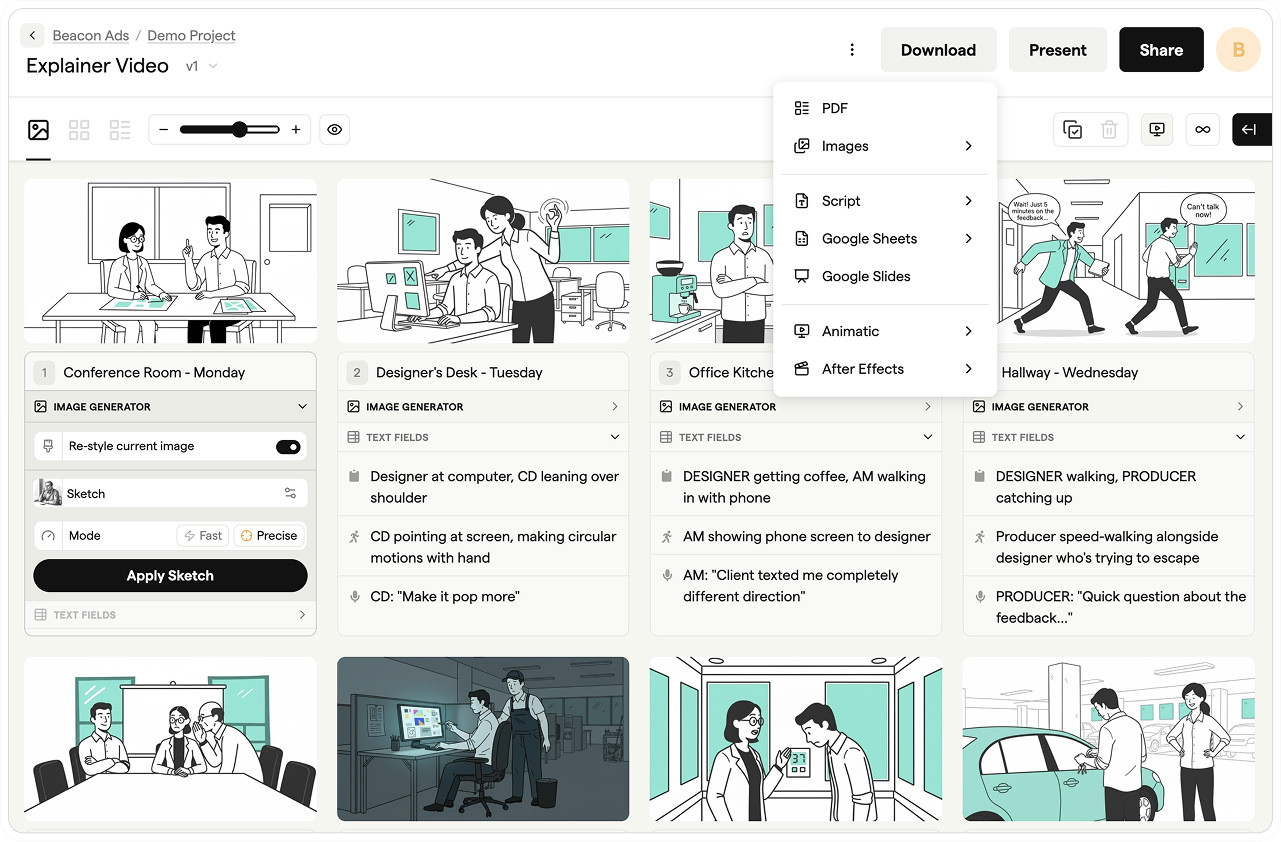
Storyboard software for video agencies & brand teams
One workspace for storyboards, animatics, comments, and approvals. Spend time on the creative, not the back-and-forth.
Essential terms to know
When you start reading about documentary treatments, you’ll see a lot of similar terms. Namely: documentary proposal, documentary synopsis and documentary logline. While there’s a lot of overlap between these terms, it’s good to know the differences.
- Documentary treatment
Much like a script, your film treatment details exact scenes, main characters and story structure. It’s a constantly developing document that you’ll need to tweak as the story comes together. Large funding agencies might want to see your treatment if you approach them for fundraising—however, this can be difficult in the early stages of the pre-production process due to the unknown nature of documentaries.
- Documentary proposal
A group of documents that detail your documentary project, including story synopsis, logline, documentary treatment, production team bios, budget and distribution plan. Potential funders might ask for your documentary proposal—it’s a bit like seeing a business plan.
- Documentary synopsis
A synopsis is a short overview of your story, explaining why it’s important and how you’re going to tell it. A synopsis varies in length from a couple of paragraphs to a few pages.
- Documentary logline
A logline is a one-sentence summary of your film that entices someone to read the entire script. Loglines explain the key parts of your screenplay—like the main character, inciting incident, central conflict, and antagonist—in a tight, hooky sentence.
- Documentary tagline
A tagline is like a mini version of a logline. It's a quick, catchy sentence used by marketers and distributors to advertise and sell your film. You’ll often see it on movie posters, DVD covers, film catalogues, adverts or TV guides.
Why you need a documentary treatment
Your documentary treatment is a written document that describes your entire documentary project. As a filmmaker, it’ll help you get all your ideas on the page, working through potential themes and story angles. So it’s an essential part of the development process.
But your documentary treatment is useful for other reasons, too. You’ll need it to get potential investors, participants or supporters involved in your film. It explains your vision in word form, helping others to understand what you’re trying to create.
While it’s important to invest time in making your documentary treatment as good as it can be, you’ll constantly need to update it as the project progresses. It’s an evolving document that’ll flex as you move through the writing process.
How long should a documentary treatment be?
While there are strict rules for how long a spec script should be, documentary treatments can vary quite a lot. Your treatment needs to be short enough to be snappy and engaging, but long enough to cover all the plot points and sell the story.
If you’re writing without a specific audience in mind, then a ten-page document is a good length for a documentary treatment. If you’re writing your treatment for someone specific—like a reader at a production company—then screenwriter John August suggests asking them what they’re looking for. Sometimes readers have a certain page count in mind.
That said, there are no concrete rules. James Cameron, for example, is known for writing epic 70-page film treatments. His treatment for Terminator is worth a read... if you have time to kill.
What to include in a documentary treatment
When formatting your documentary treatment, you should write it in the same way that you would write a present-tense short story. It needs to include the key plot points and give a flavour of the tone you’re shooting for, but it shouldn’t be overly stylised—like a novel, for example.
Your treatment doesn’t need to include the whole story, so it’s a good idea to cut out non-critical subplots. You should aim for something that outlines your basic three-act structure but without the screenplay format. Stick to the meat of the story and the main characters.
Here’s a list of things that you’ll want to include in your documentary treatment:
- The working title of your documentary. This one’s essential.
- Your name and contact details. So if someone does want to throw some cash your way, they know how to reach you.
- Logline. Explain what your story’s about in a couple of lines.
- Explanation of act one. Where are we? What’s this documentary about? Who are the main characters? What do they want? What’s the tone? What’s the setup?
- Explanation of act two. What pushes these characters to change? What’s the conflict? Where’s the story going?
- Explanation of act three. How does the story reach a resolution? What’s the climax?
- Final wrap-up. Where do we leave the characters? What happens at the very end? Is there an epilogue?
Naturally, the writing process for documentary filmmaking is different to a regular film or TV show because there are a huge amount of unknowns. But if you follow this structure as closely as you can, you’ll be golden.
Get your FREE Filmmaking Storyboard Template Bundle
Plan your film with 10 professionally designed storyboard templates as ready-to-use PDFs.

Tips for writing a documentary treatment
Naturally, every documentary treatment is different. But there are a few golden rules that’ll ensure your treatment’s up to industry standards.
1. Use the active voice and present tense
Tell the reader what they’ll see and hear on the screen as the documentary unfolds, from beginning to end. Don’t say ‘Apollo was punched by Rocky’—this is in the passive voice and past tense. Instead, write ‘Rocky punches Apollo’. This will make your treatment feel more alive, immersing the reader in the story.
Check out this post for more information on the active and passive voice.
2. Be specific
Your treatment needs to describe situations, locations and characters in precise detail to make the story jump off the page. Use vivid, colourful language and avoid generic phrases or cliches.
3. Use nontechnical language
Not everyone reading your documentary treatment will be a cinematic expert or screenwriting buff. Make sure you don’t use any inside filmmaking terms that the average reader won’t understand.
4. Get your formatting right
Introduce characters in CAPS, followed by their age in brackets: ‘ROCKY (25) greets PAULIE (40s). High fives. Paulie slaps Rocky on the back.’
5. Only describe what’s seen and heard on camera
Don’t include characters’ desires, emotions or inner thoughts. And definitely don’t describe camera directions.
Get feedback
Once you’ve got a first draft of your documentary film treatment together, it’s time to show it to some people. Hold off on sending it to funders or interviewees until you’ve had a friend or collaborator cast an eye over it, though. They’ll probably have useful feedback that’ll make your treatment even better.
Sharper preproduction, less back-and-forth
Workflow tips and Boords product updates for video and brand teams, twice a week.
More from the blog



Get every video signed off before production starts
Create scripts, storyboards, and animatics with your team.
Collect client feedback, keep every version on record, and go into production knowing exactly what was approved.